Can Chlorella Actually Grow Your Hair?
Let's Look at the Evidence.
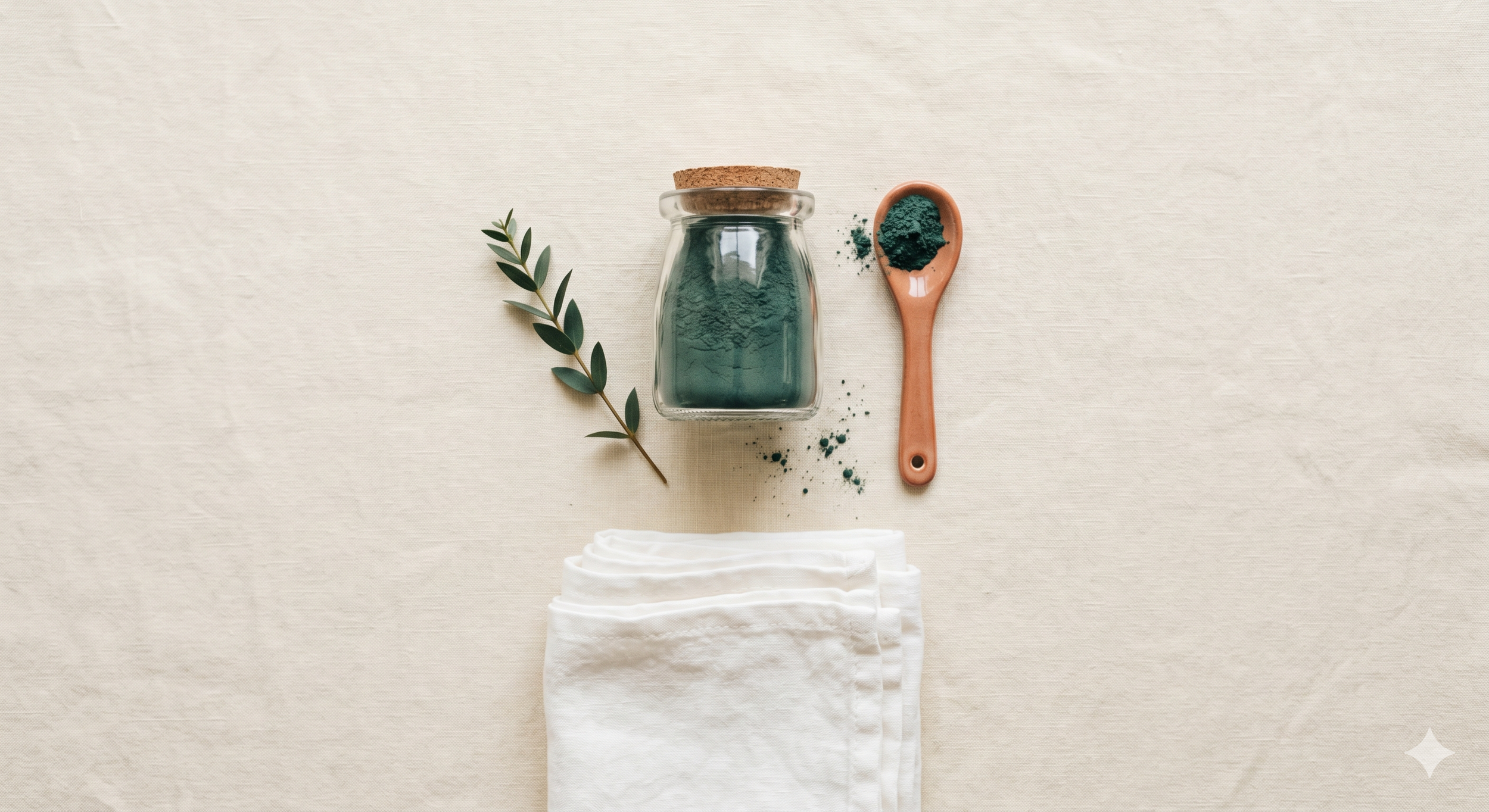
A little jar of chlorella powder next to a white hair towel.
The Green Hype Machine Is At It Again
Chlorella walks into a room, and suddenly everyone's talking about glowing skin, improved energy, detox, and... hair growth? Yes, the emerald-green freshwater algae that's been a staple supplement in Japan since the 1970s has officially entered the hair wellness conversation, and it showed up with quite a reputation.
Before we get swept up in the current of green smoothie enthusiasm, let's do what we always do here: slow down, read the actual science, and figure out what's real versus what's really compelling marketing.
The short version? Chlorella is genuinely nutritious, some of the nutrients it contains do have connections to hair health, and there's even a small but growing body of research on chlorella and hair specifically. But the story is more nuanced than "eat algae, grow hair." (Shocking, I know.)
Let's get into it.
First: What Is Chlorella, Exactly?
Chlorella is a single-celled freshwater microalgae, and it has been commercially produced and sold as a dietary supplement for decades. It's most commonly available in powder, tablet, or capsule form, and it has a characteristic deep green color thanks to some of the highest chlorophyll concentrations found in any food source.
A 2020 review published in Nutrients by Bito et al. described chlorella as a nutritionally dense supplement containing an array of nutrients that are often absent or underrepresented in plant-based diets, including vitamins B12 and D (1).
And nutritionally, it does not disappoint. A 2023 review in Nutrients examined the macronutrient profile of chlorella in depth and reported that chlorella biomass consists of over 60% protein by dry weight, with a complete essential amino acid profile, plus meaningful amounts of polyunsaturated fatty acids and dietary fiber (2).
That protein content is notable. Your hair is made almost entirely of keratin, which is a protein. Amino acids are the building blocks of that protein. So, while "eat algae, grow hair" is oversimplified, the idea that high-quality protein intake supports hair structure is grounded in basic physiology.
The Nutrient Lineup: Who's Showing Up for Hair Health?
Let's walk through the nutrients in chlorella that have documented connections to hair health. Some of this evidence is strong; some is more preliminary. I'll be clear about the difference.
Iron
Iron is the most well-studied nutritional contributor to hair loss, particularly in women. Your hair follicles store iron in the form of ferritin, and when your body's iron stores drop, it borrows from those reserves and redirects them to more critical functions, like oxygen transport to your heart. The hair follicles are, unfortunately, not high on the priority list.
A 2023 retrospective study published in Tzu Chi Medical Journal examined 155 women presenting with hair loss and found that iron deficiency accounted for more than 70% of cases. It also found that patients who showed subjective improvement in hair regrowth also demonstrated significantly higher increases in ferritin levels after iron supplementation (3).
That said, the overall evidence on iron and hair loss has some nuance baked in. A 2022 systematic review and meta-analysis in Skin Appendage Disorders found that while iron deficiency is common in women with nonscarring alopecia, the evidence for universal iron screening or supplementation for hair loss is not yet definitive, and the relationship may differ by type of hair loss (4).
Where does chlorella come in? It's a reasonable dietary source of iron. One well-known brand reports providing about 28% of the daily value per 3-gram serving. That said, the form of iron in plant sources (non-heme iron) is less absorbable than the heme iron found in animal products, and bioavailability can vary by product.
Chlorella is not a standalone iron treatment, but it can contribute to overall iron intake, particularly for plant-based eaters who may have fewer high-bioavailability options.
Vitamin B12
Vitamin B12 supports red blood cell production, which is important for delivering oxygen and nutrients to hair follicles. B12 deficiency has been associated with diffuse hair loss in some studies, although the evidence is not entirely consistent across research, and large-scale clinical trials on B12 supplementation for hair growth specifically are still lacking.5
One of the more interesting facts about chlorella is its B12 content, specifically because most plant foods either don't contain meaningful amounts of B12 or contain an inactive form called pseudovitamin B12 that your body cannot use. Spirulina, for example, predominantly contains the pseudovitamin form.
Chlorella tells a different story. Research has characterized the B12 in chlorella tablets and found that true, biologically active vitamin B12 (cobalamin) is the predominant form in chlorella, which is meaningfully different from many other algae supplements (6).
A small clinical study enrolled 17 vitamin B12-deficient vegans and vegetarians who supplemented with 9 grams of Chlorella pyrenoidosa daily for approximately 60 days. Serum methylmalonic acid (a functional marker of B12 status) dropped by an average of 34%, and 88% of participants showed at least a 10% reduction, suggesting that the B12 in chlorella is bioavailable in humans (7).
That said, a 2022 analysis of 57 commercial algae products found high variability in B12 content across both chlorella and spirulina products (12), which is an important reminder that not all supplements are created equal. If you are relying on chlorella as a primary B12 source, it is worth looking for a product that has tested and quantified its actual B12 content.
Zinc
Zinc plays a role in DNA repair, immune function, and cell proliferation, all of which matter for the fast-dividing cells of hair follicles. Zinc deficiency has been consistently associated with alopecia areata (an autoimmune form of hair loss) specifically. A 2023 prospective case-control study found significantly lower serum zinc concentrations in patients with alopecia areata compared to healthy controls, with zinc deficiency being notably more prevalent in more severe disease forms (8).
For other hair loss types, the picture is less clear. A large 2025 cross-sectional study in Healthcare that included nearly 24,000 patients found that those with hair loss complaints had slightly lower median zinc levels than controls, but both groups fell within the normal range, and the researchers concluded the difference was not clinically significant enough to recommend routine zinc testing in primary care hair loss workups (9).
Chlorella contains zinc, and it may contribute modestly to overall zinc status, but the evidence does not suggest that chlorella-derived zinc alone is a meaningful intervention for hair loss.
Protein and Amino Acids
Hair is approximately 95% keratin, a structural protein built from amino acids. Adequate dietary protein is necessary for hair follicle function and hair shaft integrity. Severe protein deficiency can cause hair loss, and even suboptimal protein intake can potentially affect hair quality over time (10).
Chlorella's protein content, as noted above, is substantial, over 60% by dry weight, and it contains all nine essential amino acids. A 2023 review in Nutrients highlighted that chlorella proteins increase intramuscular free amino acid levels and are well-suited as a high-quality protein source for a variety of dietary contexts (2).
One important caveat: protein digestibility in chlorella can be lower than in animal-source proteins, partly due to the tough cell wall structure. Cell-wall-broken chlorella products generally have better bioavailability. It’s worth checking your product if this matters to you.
Is There Research on Chlorella and Hair Directly?
This is where we must be especially honest, because while the nutrient story is fairly solid, the direct clinical evidence specifically on chlorella and hair growth is quite limited.
There is one recent study worth mentioning. A 2024 paper published in Advances in Bioengineering & Biomedical Science Research evaluated a commercial product called Probiotics Chlorella Pyrenoidosa Powder for its effects on hair density in human subjects over 12 weeks. The researchers reported increases in both local and whole-scalp hair density assessed via dermatoscope and photo documentation (11).
That is encouraging! But here is the responsible context: this was a single study of a combination product (probiotics plus chlorella), not isolated chlorella. It is early-stage research, the study has significant limitations, and it has not yet been replicated. The authors note that "clinical evidence for natural ingredients remains insufficient" in the hair loss space. This is not a reason to dismiss the finding, but it is also not a reason to declare chlorella a proven hair growth intervention.
What we can say is that plausibility is there. The nutrients in chlorella have mechanistic connections to hair follicle function, and early direct research is promising. We just need more of it.
What Chlorella Is Not
Let's be clear about what the evidence does not support, because wellness marketing in this space can get...creative.
Chlorella is not a treatment for any specific hair loss condition. If you have androgenetic alopecia, alopecia areata, or telogen effluvium, chlorella is not going to replace evidence-based treatments. Please work with a dermatologist.
Chlorella's "detox" claims, including the idea that it removes hair-damaging toxins, are largely unsupported for the hair specifically. There is some evidence that chlorella can help reduce heavy metal exposure (including methylmercury), which is an interesting finding for general health, but the leap from "reduces heavy metals" to "grows your hair" is not established.
The supplement industry is not regulated by the FDA for efficacy, and quality varies enormously across chlorella products. If you choose to supplement, look for third-party tested options.
More is not better. Excess supplementation of certain nutrients, including vitamin A (which chlorella does contain), can actually cause hair loss. This is a reminder that supplements are not categorically safe at any dose.
The Bottom Line
Chlorella is a nutritionally impressive food that contains several nutrients with documented connections to hair health: iron, bioavailable B12, zinc, and complete protein. If your diet is leaving you short on any of these, chlorella could reasonably contribute to better overall nutritional status, which may in turn support hair health.
Whether chlorella directly stimulates hair growth in people who are not nutrient-deficient? The direct clinical evidence is very early and limited. The mechanistic plausibility exists; the robust, replicated human trial data does not yet.
This is a "nutritionally interesting, clinically preliminary" category. Not snake oil. Not a miracle. Just a green algae with a genuinely solid nutrient profile and a growing body of research that warrants watching.
As with most nutrition questions, the foundation matters most: adequate overall protein, iron stores in a healthy range, sufficient B12, and a diet that is not running on empty. If chlorella helps you get there, especially if you are plant-based, that is a legitimate reason to consider it.
But if you are losing significant hair, please see a dermatologist before you buy the powder. A blood panel (ferritin, B12, vitamin D, complete blood count) is worth a lot more than any supplement.
A Quick Note on Chlorella Safety
Chlorella is generally recognized as safe by the FDA and is widely consumed globally. The most common side effects are gastrointestinal (nausea, diarrhea, green-colored stools, which is harmless) and typically occur in the first week of use. People with autoimmune conditions or those on warfarin should consult their healthcare provider before supplementing, as chlorella's immune-modulating and vitamin K content may be relevant. As with any supplement, sourcing from a reputable, third party-tested brand matters.
References
1. Bito T, Okumura E, Fujishima M, Watanabe F. Potential of Chlorella as a Dietary Supplement to Promote Human Health. Nutrients. 2020;12(9):2524. https://doi.org/10.3390/nu12092524
2. Lorenzo, K., Santocildes, G., Torrella, J. R., Magalhães, J., Pagès, T., Viscor, G., Torres, J. L., & Ramos-Romero, S. (2023). Bioactivity of Macronutrients from Chlorella in Physical Exercise. Nutrients, 15(9), 2168. https://doi.org/10.3390/nu15092168
3. Lin CS, Chan LY, Wang JH, Chang CH. Diagnosis and treatment of female alopecia: Focusing on the iron deficiency-related alopecia. Tzu Chi Medical Journal. 2023;35(4):322-328. https://doi.org/10.4103/tcmj.tcmj_95_23
4. Treister-Goltzman Y, Yarza S, Peleg R. Iron Deficiency and Nonscarring Alopecia in Women: Systematic Review and Meta-Analysis. Skin Appendage Disorders. 2022;8(2):83-92. https://doi.org/10.1159/000519952
5. Almohanna HM, Ahmed AA, Tsatalis JP, Tosti A. The Role of Vitamins and Minerals in Hair Loss: A Review. Dermatology and Therapy. 2019;9(1):51-70. https://doi.org/10.1007/s13555-018-0278-6
6. Watanabe F, Takenaka S, Katsura H, et al. Characterization and Bioavailability of Vitamin B12-Compounds from Edible Algae. Journal of Nutritional Science and Vitaminology. 2002;48(5):325-331. https://doi.org/10.3177/jnsv.48.325
7. Merchant RE, Andre CA. A Review of Recent Clinical Trials of the Nutritional Supplement Chlorella pyrenoidosa in the Treatment of Fibromyalgia, Hypertension, and Ulcerative Colitis. Alternative Therapies in Health and Medicine. 2001;7(3):79-91. (Supplementary data on B12 status referenced via: Zeinalian R et al. Nutritional Supplementation with Chlorella pyrenoidosa Lowers Serum Methylmalonic Acid in Vegans. J Renew Energy Environ. 2016;3:39-44.) https://pubmed.ncbi.nlm.nih.gov/26485478/
8. Lalosevic J, Gajic-Veljic M, et al. Serum Zinc Concentration in Patients with Alopecia Areata. Acta Dermato-Venereologica. 2023. https://pmc.ncbi.nlm.nih.gov/articles/PMC10561101/
9. Liran O, Vered S, Cohen B, et al. Hair Loss and Zinc Deficiency: A Cross-Sectional Study. Healthcare. 2025;13(22):2965. https://doi.org/10.3390/healthcare13222965
10. Guo EL, Katta R. Diet and hair loss: effects of nutrient deficiency and supplement use. Dermatology Practical & Conceptual. 2017;7(1):1-10. https://doi.org/10.5826/dpc.0701a01
11. Lin, Y.-K., Lin, Y.-H., & Chiang, C.-F. (2024). Synergistic Effects of Natural Extracts and Probiotics on Hair Care: A Study on a Novel Complex Formulation. Advances in Bioengineering and Biomedical Science Research, 7(5), 1–8. https://www.opastpublishers.com/open-access-articles/synergistic-effects-of-natural-extracts-and-probiotics-on-hair-care-a-study-on-a-novel-complex-formulation.pdf
12. van den Oever, S. P., & Mayer, H. K. (2022). Biologically active or just “pseudo”-vitamin B12 as predominant form in algae-based nutritional supplements? Journal of Food Composition and Analysis, 109, 104464. https://doi.org/10.1016/j.jfca.2022.104464
Disclaimer: This post is for educational and informational purposes only and is not a substitute for medical advice. If you are experiencing hair loss, please consult with a board-certified dermatologist or your healthcare provider.